

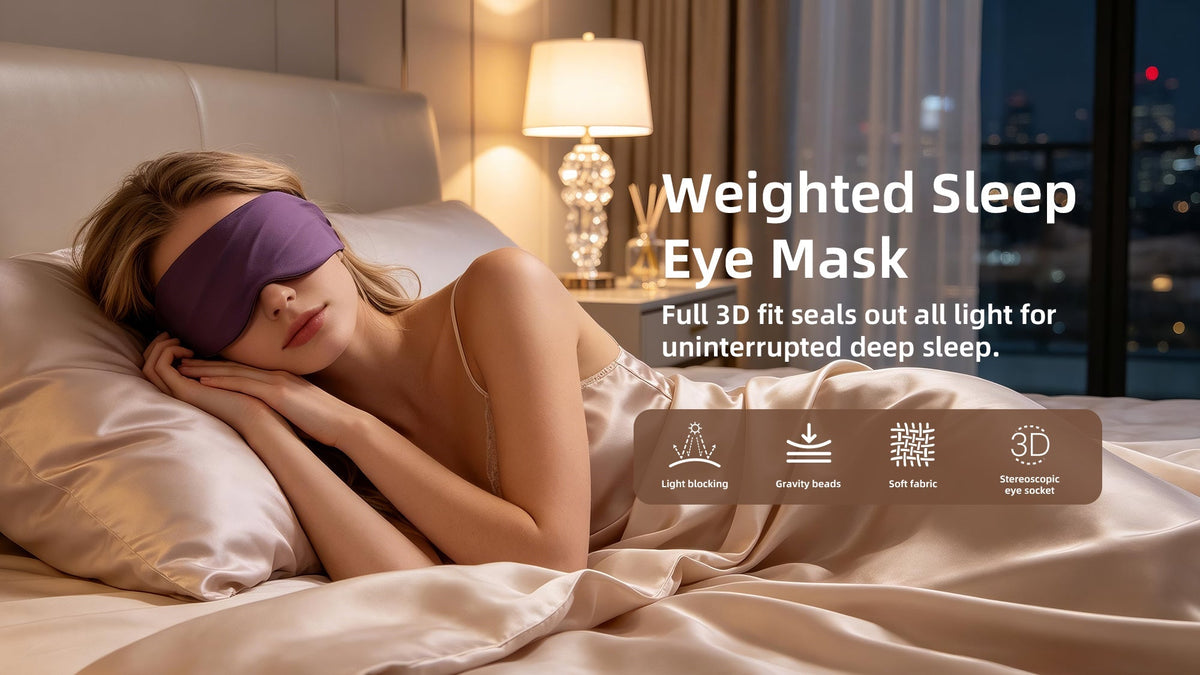
Best Sleep Mask for CPAP Users: How to Stop Mask Leaks & Strap Interference
Continuous Positive Airway Pressure (CPAP) therapy remains the gold standard treatment for Obstructive Sleep Apnea (OSA). However, while your CPAP machine keeps your airway open throughout the night, using it alongside a sleep mask often creates a frustrating mechanical conflict.
Many CPAP users experience pressurized air escaping from the top of the nasal bridge, directing continuous micro-drafts straight across their corneas. The result is waking up with gritty, inflamed dry eyes, blepharitis, or compromised eye hydration.
Worse, attempting to wear a standard sleep mask over or under your CPAP headgear leads to "strap warfare"—thick buckles collide, masks shift on your face, and the CPAP seal breaks the moment you turn onto your side.
In this 2026 CPAP Sleep Mask Guide, we explore the biomechanics of CPAP-induced dry eye and break down how to choose a 3D contoured blackout mask engineered to integrate seamlessly with CPAP headgear.
1. The CPAP Dilemma: Upward Air Leaks & Nocturnal Dry Eye
Even high-end CPAP masks (such as nasal pillows, nasal cradles, and full-face interfaces) can suffer from micro-displacements during sleep. When air leaks from the top cushion margin, it follows the path of least resistance—straight upward into the orbital socket.
+----------------------------------------------------------------------------------------------------+
|                                CPAP OCULAR STRESSORS & THE 3D SHIELD FIX                           |
+------------------------------+---------------------------------------+-----------------------------+
| CPAP ISSUE                   | IMPACT ON THE EYE & SLEEP             | 3D SLEEP MASK SOLUTION      |
+------------------------------+---------------------------------------+-----------------------------+
| Upward Air Jetting           | Strips tear film lipid & aqueous layer| Sealed Ocular Microclimate  |
| Floppy Eyelid Syndrome (OSA) | Eyelids open slightly under pressure  | 360° Recessed Eye Dome      |
| Headgear Strap Stacking      | Thick bands create skull pressure     | Ultra-Flat Low-Profile Glide|
| Mask Displacement on Pillows | Side-sleeping lever breaks seal       | Tapered Zero-Resistance Wing|
+------------------------------+---------------------------------------+-----------------------------+
The Ocular Risk of Pressurized Air
Continuous airflow across closed or partially open eyelids accelerates tear evaporation in minutes. For OSA patients—who already have a higher clinical prevalence of floppy eyelid syndrome and meibomian gland dysfunction—this constant drying leads to corneal abrasions, foreign-body sensations, and chronic morning redness.
Why Traditional Flat Sleep Masks Fail with CPAP
-
Pushes Fabric into Eyes: When air leaks under a flat cloth mask, the pressurized air balloons the fabric, causing it to flap against the eyelashes and cornea.
-
Breaks the CPAP Nasal Seal: Flat masks have thick elastic bands that sit right across the upper cheekbone, breaking the silicone seal of your CPAP cushion and worsening the air leak.
 2. The Mechanics of Strap Interference: How to Layer Without Bulk
Wearing a CPAP mask requires 2 to 4 stability straps running across your crown, temples, and neck. Introducing a poorly designed sleep mask adds a fifth point of friction.
                  CORRECT CPAP & 3D SLEEP MASK LAYERING PROTOCOL

   [ Step 1: 3D Sleep Mask First ] ──► Low-profile elastic band sits flush against skull
                  │
                  ▼
   [ Step 2: CPAP Mask Over Top ]  ──► Silicone cushion seals over the nose/mouth
                  │
                  ▼
   [ Step 3: CPAP Headgear Straps ]──► Headgear anchors over the flat sleep mask strap
+----------------------------------------------------------------------------------------------------+
|                               CPAP COMPATIBILITY: CONVENTIONAL VS. FISMOOL                         |
+------------------------------+---------------------------------------+-----------------------------+
| DESIGN FACTOR                | CONVENTIONAL SLEEP MASKS              | FISMOOL 3D CPAP-COMPATIBLE  |
+------------------------------+---------------------------------------+-----------------------------+
| Temporal Wing Profile        | Bulky 0.5" foam walls (Breaks seal)   | Ultra-tapered flush wings   |
| Strap Fastener Design        | Thick plastic clips & wide Velcro     | Low-profile glide slider    |
| Eye Socket Depth             | Shallow (Lids touch fabric)           | Deep recessed moisture dome |
| Nasal Bridge Clearance       | Collides with CPAP nose cushion       | Sculpted ergonomic arch     |
| 100% Light Blackout          | Compromised by strap overlap          | Total 0-lux darkness        |
+------------------------------+---------------------------------------+-----------------------------+
To eliminate strap interference:
-
Choose Ultra-Thin Side Wings: The sleep mask must taper to a razor-thin edge at the temples so the CPAP silicone frame can rest smoothly against the face without creating a gap.
-
Eliminate Hard Buckles at the Crown: Fasteners must be ultra-flat glide sliders located away from where your CPAP headgear crown strap sits.
-
Layer the Sleep Mask Underneath: Always put your 3D sleep mask on first, then seat your CPAP interface over top. This allows the 3D mask to serve as a soft, protective cushion between the CPAP strap and your skin.
3. Top CPAP Mask Types & 3D Sleep Mask Synergy
Different CPAP interfaces interact with sleep masks in distinct ways. Here is how to pair them effectively:
+------------------------------------------------------------------------------------------------+
|                             CPAP INTERFACE COMPATIBILITY MATRIX                                |
+--------------------------+-----------------------------------+---------------------------------+
| CPAP MASK TYPE           | COMMON AIR LEAK CHALLENGE         | 3D SLEEP MASK BENEFIT           |
+--------------------------+-----------------------------------+---------------------------------+
| Nasal Pillow (e.g. P10)  | Minimal frame; side pillow leaks  | Deep domes protect lashes       |
| Nasal Cradle (e.g. N30i) | Top-of-head hose; cheek friction  | Flat side wings prevent shift   |
| Full Face (e.g. F20)     | High bridge leaks blow into eyes  | Acts as physical moisture block |
+--------------------------+-----------------------------------+---------------------------------+
1. Nasal Pillow & Cradle Masks (ResMed AirFit P10, P30i, Philips DreamWear)
Nasal pillows offer the smallest footprint. When paired with a 3D contoured mask, you achieve complete orbital coverage and 100% light blackout while the CPAP hose connects cleanly below the nose or at the crown of the head.
2. Full-Face Masks (ResMed AirFit F20, F30i)
Full-face masks cover both nose and mouth, placing silicone cushions closer to the lower eyelid. A 3D sleep mask with an elevated eye cavity acts as a protective physical barrier, deflecting any unexpected upward exhaust air away from your delicate corneas.
 The Fismool Solution: Engineered for CPAP Users & Side Sleepers
At Fismool, we engineered the 3D Ergonomic Sleep Mask to resolve the exact pain points reported by CPAP patients:
-
Ocular Moisture Dome: Deeply recessed eye cavities seal in natural tear vapor and physically shield the eye surface from escaped CPAP air jets.
-
Zero-Interference Slim Wings: Tapered side profiles allow CPAP silicone frames and headgear straps to sit flush against the face without breaking the air seal.
-
Low-Profile Anti-Snag Band: Smooth elastic slider sits completely flat, eliminating pressure hotspots when layered under CPAP headgear.
-
Anatomical Nasal Arch: Conforms comfortably across the bridge of the nose without crowding or displacing nasal pillows or nasal cradle cushions.
 Frequently Asked Questions
Q1: Can you wear a sleep mask with a CPAP machine?
Yes. Wearing a 3D contoured sleep mask with a CPAP machine is highly effective. It protects your eyes from upward air leaks that cause dry eyes while providing 100% light blackout. For optimal comfort, choose a mask with ultra-thin side wings and flat straps that will not interfere with CPAP headgear.
Q2: Do you put the sleep mask over or under the CPAP mask?
Put the sleep mask on underneath your CPAP headgear straps. Put on the 3D sleep mask first so the eye domes sit securely over your eyes, then place your CPAP cushion over your nose/mouth and secure the CPAP headgear over the flat sleep mask band.
Q3: How do 3D sleep masks prevent CPAP-induced dry eyes?
A 3D sleep mask features raised memory foam domes that rest against the orbital bone, forming a protective moisture chamber. This barrier blocks stray pressurized air escaping from CPAP nasal seals from blowing across the cornea, preserving your natural tear film overnight.
Protect Your Eyes & Maximize CPAP Therapy
Stop letting upward air leaks and clashing headgear disrupt your sleep apnea recovery. Explore the Fismool 3D Ergonomic Sleep Mask Collection and experience zero-pressure, leak-free 100% blackout sleep engineered for CPAP compatibility.


