
Skip to content
Why Your Eyes Dry Out Overnight: The Physics of "Ocular Microclimate" During Sleep

Why Your Eyes Dry Out Overnight: The Physics of "Ocular Microclimate" During Sleep

If you wake up with burning, gritty, or chronically red eyes, you are likely blaming your screen time or your air conditioner. While those are contributing factors, the real culprit is a breakdown in your Ocular Microclimate—the microscopic layer of humidity suspended directly over your corneas while your eyelids are closed.

For decades, sleep ergonomics focused entirely on light blocking. However, advanced sleep technology in 2026 has revealed that evaporative moisture loss during the 8-hour sleep cycle is one of the leading hidden causes of sleep fragmentation, morning eye fatigue, and accelerated skin aging around the orbital zone.

Here is the underlying science of why your eyes dry out at night, and how modern material engineering is solving it.


The Anatomy of Nocturnal Moisture Loss

When you sleep, your eyes rely on a continuous, uninterrupted tear film to deliver oxygen and cellular hydration. This delicate lipid layer requires a perfectly stable ambient humidity to prevent evaporation.

However, modern bedrooms create a hostile environment for this biological shield:

  1. Forced-Air Evaporation: Air conditioning units and winter heating systems generate continuous convection currents. This moving air aggressively pulls moisture away from the face.

  2. Nocturnal Lagophthalmos (Incomplete Eyelid Closure): Clinical studies show that up to 20% of the population does not close their eyelids completely during deep sleep. Even a sub-millimeter gap exposes the vulnerable cornea to the room's dry air draft, causing severe localized dehydration.


What is an "Ocular Microclimate" and How Do We Protect It?

In textile and ergonomic engineering, a "microclimate" refers to the local atmospheric conditions created between a piece of wearable gear and the human skin.

Traditional flat eye masks fail because they press directly against the eyelids, flattening the eyelashes and absorbing the eye's natural moisture like a sponge. When the fabric becomes saturated, it allows room air to bypass the perimeter, destroying the relative humidity over the eye socket.

To maintain a healthy Ocular Microclimate, a sleep device must fulfill three strict engineering parameters:

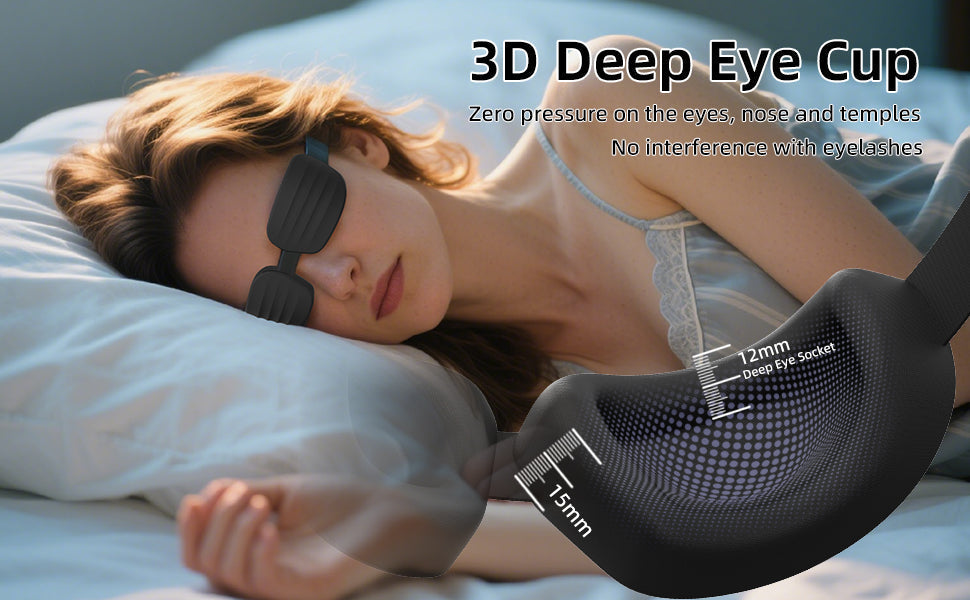
  • True 3D Spatial Cavity: The mask must provide a deep orbital chamber (at least 15mm) so that the eyelids can blink freely during REM (Rapid Eye Movement) cycles without friction.

  • Hermetic Moisture Seal: It must feature specialized, medical-grade contours that create a physical barrier around the zygomatic and brow bones, trapping natural ocular respiration.

  • Thermal Equilibrium: The materials must prevent heat buildup while preserving humidity. High heat leads to sweat accumulation, which disrupts the delicate pH balance of skin and tear ducts.


Engineering the Solution: The Fismool 2.0 Approach

Recognizing the shift from "basic shading" to "advanced bio-ergonomics," the design team behind the Fismool Deep Sleep 3D Mask introduced Adaptive Moisture Eye Cups.

Instead of relying purely on foam layers, this system uses ultra-soft silicone barriers that act as a terrarium for your eyes. By locking in the body's natural moisture evaporation without adding heat or eye pressure, it keeps the localized humidity within the orbital cavity at an optimal 60% to 70% all night long—even in heavily air-conditioned rooms.

The Takeaway for High-Performance Rest

Achieving restorative rest is no longer just about turning off the lights; it is about protecting your body's vital biological barriers. If you are using artificial tears or waking up with irritated eyes, it is time to upgrade your sleep setup from a passive piece of cloth to a proactive moisture-sealing environment.

Protect your corneas, preserve your sleep quality, and wake up with fully hydrated, refreshed eyes.