

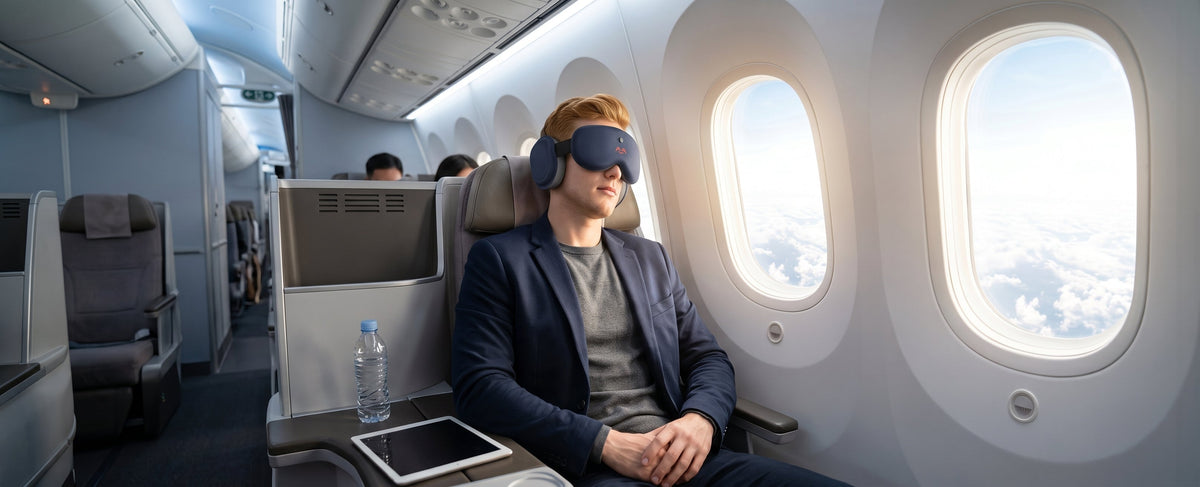
The Frequent Flyer’s Sleep Kit: How to Achieve 100% Blackout on Red-Eye Flights (2026 Guide)
Taking a red-eye or long-haul flight is often the most efficient way to cross time zones without losing a business day. However, stepping off the plane sharp, energized, and ready for a morning meeting requires landing with real, consolidated sleep—not just fitful micro-naps.
Unfortunately, commercial airplane cabins are designed around passenger safety and operations, not circadian recovery. Between flickering seatback screens, sudden overhead service lights, dry pressurized air, and restrictive headrests, achieving restorative sleep in the sky is an uphill battle.
In this 2026 Frequent Flyer’s Sleep Guide, we analyze the physiological hurdles of in-flight rest and assemble the definitive carry-on sleep kit to help you achieve true 100% blackout and physical relaxation at 35,000 feet.
The Cabin Ecology: Why Sleeping on Planes Is So Difficult
Understanding the three major sensory saboteurs in an aircraft cabin is the first step toward overcoming them:
+----------------------------------------------------------------------------------------------------+
|                                    IN-FLIGHT SENSORY OBSTACLES & FIXES                             |
+------------------------------+---------------------------------------+-----------------------------+
| CABIN STRESSOR               | PHYSIOLOGICAL IMPACT                  | 2026 SLEEP KIT SOLUTION     |
+------------------------------+---------------------------------------+-----------------------------+
| Ambient Blue-Light Glare     | Halts pineal melatonin release        | Sculpted 100% 3D Blackout   |
| 10–15% Relative Humidity     | Rapid tear film & corneal evaporation | Ocular Microclimate Chamber |
| Narrow Airplane Headrest     | Mask shifts & buckles press skull     | Ultra-Flat Low-Profile Band |
| Jet Engine Noise (~85 dB)    | High acoustic arousal threshold       | Passive Acoustic Foam Seal  |
+------------------------------+---------------------------------------+-----------------------------+
-
Photonic Pollution: Even when main cabin lights dim, ambient illumination from galley curtains, seatback monitors, and neighbor reading lights stays above 50–100 lux—enough to suppress melatonin production through closed eyelids.
-
Extreme Ocular Dehydration: Aircraft cabins maintain humidity levels below 15% (drier than the Sahara Desert). Flat fabric eye covers wick away what little moisture your eyes have left, leading to scratchy, bloodshot eyes on landing.
-
Headrest Interference & Slip: Thick plastic buckles and chunky side straps get wedged between the back of your head and the firm airline seat, pushing the mask forward and causing immediate light leaks every time you lean your head back.
 The Frequent Flyer’s 2026 Sleep Kit Breakdown
To transform an economy or premium seat into an uninterrupted sleep pod, curate your carry-on with these four essential pillars:
+------------------------------------------------------------------------------------------------+
|                             THE CARRY-ON SLEEP KIT AT A GLANCE                                 |
+--------------------------+-----------------------------------+---------------------------------+
| GEAR PIECE               | PRIMARY ROLE                      | SPECIFICATION BENCHMARK         |
+--------------------------+-----------------------------------+---------------------------------+
| 1. Optical Shield        | Total Photonic Isolation          | Deep 3D Cups + Nose Baffle      |
| 2. Cervical Support      | Spinal Alignment & Head Hold      | Wrap-around memory foam pillow  |
| 3. Acoustic Barrier      | White Noise / Decibel Damping     | Soft foam plugs or flat drivers |
| 4. Ocular Hydration      | Tear Film Preservation            | Preservative-free lipid drops   |
+--------------------------+-----------------------------------+---------------------------------+
1. The Optical Shield: Fismool 3D Ergonomic Travel Mask
Throw away the complimentary synthetic eye patches provided by airlines. A genuine travel-ready sleep mask must satisfy two strict criteria:
-
True 100% Blackout: A sculpted, multi-layer nasal baffle that seals out light angles coming from below (where floor aisle lighting and low seatback screens reflect).
-
3D Dome Geometry: Creates a protected ocular chamber that shields eyes from desert-dry cabin air vents while allowing natural blinking during REM cycles.
2. Ergonomic Structural Head & Neck Support
Pair your eye cover with a high-density, chin-supporting travel pillow. This prevents "nod-off reflex" (head dropping forward), keeping your airway open and your sleep mask seated flush against your face throughout turbulence.
3. Acoustic Attenuation & Sound Masking
Combine high-density passive ear protection or flat acoustic drivers with steady brown noise or airplane engine hums. This cloaks sudden operational sounds like galley carts and chime announcements.
4. Hydration & Barrier Defense
Administer a drop of lipid-based eye lubricant prior to donning your 3D mask. Because the contoured dome stays suspended over your orbital sockets, it creates an enclosed microclimate that traps tear evaporation for the entire flight duration.
 The 4-Step In-Flight Sleep Protocol for Red-Eye Routes
Follow this disciplined protocol immediately after boarding to maximize slow-wave sleep stages:
                   RED-EYE CHRONOBIOLOGICAL FLIGHT PROTOCOL

  [ Boarding Gate ] ────────► [ Cruise Altitude ] ────────► [ Mid-Flight Rest ] ────────► [ Landing ]
     T - 30 Min                  T + 45 Min                     T + 90 Min                   T - 45 Min
   • Set watch to dest.        • Fast-track beverage          • 3D Blackout Mask on        • Remove mask
   • Skip alcohol/sugar        • Hydrate eyes with drops      • 4-5 hours consolidated     • Expose to cabin light
-
Step 1: Synchronize Early: As soon as you board, set your phone and watch to the destination time zone to prime your mental circadian orientation.
-
Step 2: Decline Mid-Flight Meal Service: Eat before boarding. Digesting a heavy sodium-laden airline meal at 35,000 feet forces your metabolic system into active work, raising resting heart rate and delaying deep sleep onset.
-
Step 3: Secure Your Seatbelt Over Your Blanket: Fasten your safety belt visibly over your top layer so cabin attendants do not wake you during routine turbulence checks.
-
Step 4: Lock In Sensory Darkness: Put on your Fismool 3D Travel Mask, adjust the smooth rear slider so it sits flat against the seat rest, and engage uninterrupted rest.
Why Fismool Is the Ultimate Travel Sleep Mask
Engineered specifically for cramped spaces, long hours, and sensitive side-to-back transitions, the Fismool 3D Ergonomic Mask outperforms traditional travel eye covers:
-
Ultra-Flat Occipital Profile: The rear adjustment band is engineered without hard plastic clips, allowing your head to rest completely flat against airline headrests without skull pressure.
-
Nasal Light-Baffle Architecture: Custom molded contour blocks upward light bleed from cabin floor runners and tablet screens.
-
Lash Extension & Makeup Friendly: Deep hollow eye cavities ensure your mascara doesn't smudge and lash extensions never bend against fabric during flight.
-
Compact & Wrinkle-Resistant: High-resilience memory foam bounces back into perfect shape immediately after being unpacked from your carry-on luggage.
 Frequently Asked Questions
Q1: How do you achieve 100% light blackout on an airplane?
To achieve 100% blackout on an airplane, avoid flat fabric eye patches and use a 3D contoured mask with an integrated memory foam nose baffle (like Fismool). The 3D contour molds against the bridge of the nose to block bottom-angle light reflections from screens and floor runners.
Q2: Why do standard airline sleep masks make eyes feel dry?
Standard flat airline masks press fabric directly onto the eyelids, breaking the delicate eyelid margin seal and absorbing moisture from the tear film. In low-humidity aircraft cabins, this accelerates tear evaporation. A 3D mask forms a sealed microclimate that keeps dry air out and locks hydration in.
Q3: How do you prevent sleep masks from slipping off on airplanes?
Choose a sleep mask with an ultra-flat, high-friction elastic slider that anchors securely around the occipital bone without bulky clips. This keeps the mask firmly in place even when your head shifts against the seat wings during flight.
Upgrade Your Carry-On Gear Today
Stop arriving at your destination exhausted from fitful flights. Explore the Fismool 3D Ergonomic Sleep Mask Collection and experience the restorative power of 100% zero-pressure blackout sleep on your next journey.


