

Crossing time zones takes a toll on your physiological clock. Whether you are flying across the Atlantic for a business summit or taking an overnight redeye flight, landing exhausted, disoriented, and foggy-brained is a familiar struggle.
Most travelers blame jet lag solely on changing time zones. However, neurobiologists and sleep researchers point to two invisible cabin disrupters that severely compound travel fatigue: intermittent ambient light exposure and continuous low-frequency cabin noise.
Understanding how light and cabin acoustics disrupt your circadian rhythm—and why upgrading to a specialized 3D passive soundproofing sleep mask speeds up recovery—can transform your travel routine.
The Neurobiology of Flight Fatigue: Why Cabins Sabotage Sleep
Your body relies on external environmental cues (zeitgebers) to regulate its internal 24-hour clock. The most powerful zeitgeber is light, which acts directly on the Suprachiasmatic Nucleus (SCN) in your brain to signal alertness or trigger sleep.
When you attempt to rest on a long-haul flight, two biological breakdowns occur:
[ Airplane Cabin Environment ]
    │
    ├─► Intermittent Cabin Lighting ──► Suppresses Pineal Melatonin Release ──► Circadian Shift Fails
    │
    └─► 75–85 dB Engine Rumble      ──► Triggers Cortisol & Adrenaline     ──► Prevents Deep REM Sleep
1. Light Leaks Halting Melatonin Production
Even when cabin lights are dimmed, passing flight attendant carts, glowing seatback screens, and opening window shades flood your retinas with blue and white light. Even a brief flash of light passing through thin eyelids signals your pineal gland to halt the release of melatonin (the primary hormone responsible for sleep initiation).
2. Cabin Noise Triggering Sympathetic Nervous System
Modern jet cabins sit at a continuous ambient noise level of 75 to 85 decibels (dB). This constant acoustic vibration forces your brain to stay in a state of low-level vigilance. Even if you manage to doze off, high background noise prevents your brain from entering Slow-Wave (Deep) Sleep and REM sleep, leaving you waking up groggy with jet lag fatigue.
Why Standard Flat Travel Masks Fail at 30,000 Feet
Most travelers grab cheap, flat eye shades from an airport kiosk, only to find them ineffective mid-flight. Flat travel masks present two major structural flaws during air travel:
-
Insecure Nose Bridge Seals: As you shift positions in an upright airplane seat, flat masks slide around. Gaps form around the nasal bridge, allowing bright cabin light to flood into your eyes.
-
Corneal and Eyelid Compression: Flat masks press directly against your eyelids and eyelashes when leaned back against an airliner headrest. This pressure prevents natural rapid eye movement (REM) and leaves your eyes feeling dry, gritty, and irritated upon arrival.
The 3D Passive Soundproofing Advantage
To achieve deep recovery sleep while in transit, sleep gear must provide total light deprivation alongside acoustic dampening without putting pressure on your face.
[ Flat Airport Eye Cover ]                 [ Fismool 3D Soundproof Travel Mask ]
          │                                                  │
Slips easily in airplane seat              Wrap-around 360° temporal/ear seal
          │                                                  │
Gaps around nose leak cabin light          100% Zero-Gap nose wing seal
          │                                                  │
Direct pressure on eyelids                 Deep 20mm 3D contoured eye cavity
Instead of relying on electronic noise cancellation—which often suffers from battery death mid-flight—passive acoustic sleep masks utilize dense, multi-layer sound-dampening cotton and foam layers that wrap around the temples and ears. This design muffles high-decibel engine hums and cabin chatter naturally while creating a pressure-free dark environment over your eyes.
Spotlight: Fismool 3D Soundproof Blackout Sleep Mask
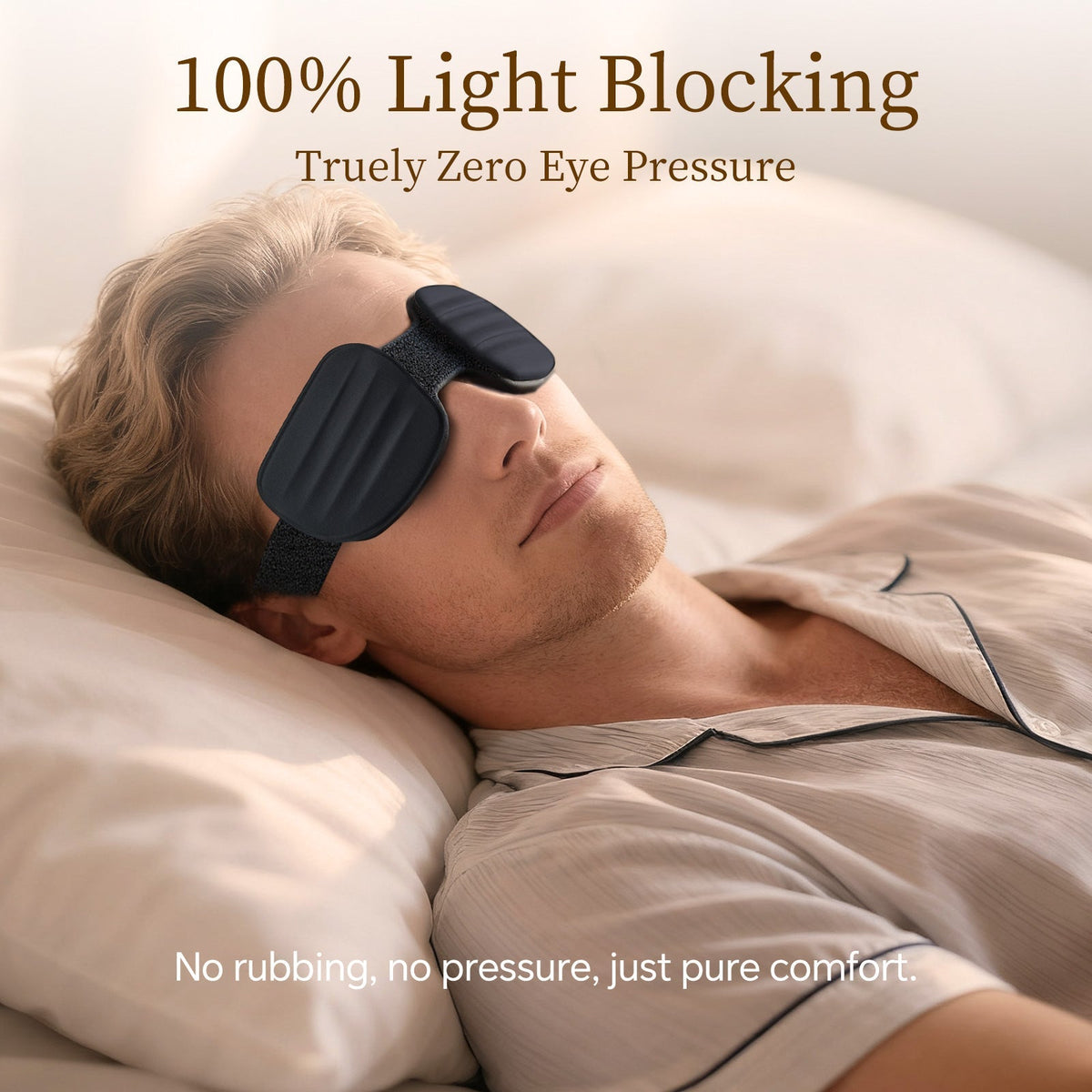
Engineered specifically to solve the compound challenges of light, noise, and travel discomfort, Fismool developed the Fismool 3D Soundproof Blackout Sleep Mask.
Tailored for frequent flyers, digital nomads, and light sleepers, this mask turns noisy airplane cabins into a private sleep sanctuary:
-
360-Degree Acoustic Shielding: Built with specialized, high-density multi-layer sound dampening core materials that physically cushion the ears and temples, muffling cabin engine noise and chatter.
-
Extra-Deep 20mm 3D Eye Cavities: Molded memory foam eyecups float completely off your eyes, allowing full blink clearance and REM eye movement without touching eyelids or eyelashes.
-
100% Light-Blocking Adaptable Nose Bridge: Features a zero-gap ergonomic nose wing that automatically seals around your nasal profile, locking out 100% of ambient cabin light regardless of how much you move.
-
Pressure-Equalizing Adjustable Strap: Wide, micro-Velcro strap distributes pressure evenly across the temporal bone rather than pulling tightly on the ears, ensuring comfort when resting against airplane seat headrests.
Comparison: Generic Travel Mask vs. Fismool 3D Soundproof Mask
| Feature / Attribute | Generic Flat Travel Mask | Fismool 3D Soundproof Mask |
| Light Blocking | 70% – 80% (Frequent nose leaks) | 100% Complete Blackout (Zero-gap wing) |
| Acoustic Mitigation | None | Passive Acoustic Shielding (Multi-layer foam) |
| Eye Cavity Depth | Flat (Crushes eyelids & lashes) | 20mm Extra-Deep (Zero pressure) |
| In-Flight Seal Fit | Slips off easily when upright | Secure wrap-around ergonomic fit |
| Electronics Required | N/A | None (Zero radiation, zero battery worry) |
Practical Protocol: How to Beat Jet Lag Using Your Fismool Mask
To minimize jet lag on your next long-haul trip, combine your Fismool 3D Soundproof Mask with these circadian alignment steps:
-
Shift Your Watch Upon Boarding: Set your device time to your destination’s local time the moment you step onto the aircraft.
-
Time Your In-Flight Sleep Window: If it is nighttime at your destination, put on your Fismool 3D Soundproof Mask immediately. The combination of total blackout and acoustic muffling signals your SCN to release melatonin.
-
Avoid Alcohol and Excess Caffeine: High cabin altitude combined with caffeine accelerates dehydration and fragments deep sleep cycles.
-
Get Direct Sunlight Upon Landing: Once you arrive at your destination, spend 15 to 20 minutes in morning sunlight to lock in your new circadian cycle.
Final Thoughts
Jet lag doesn't have to ruin your first few days in a new city or country. By protecting your brain from mid-flight cabin lighting and dampening engine noise with an ergonomic, zero-pressure tool like the Fismool 3D Soundproof Blackout Sleep Mask, you can land feeling rested, focused, and ready for your day.


